
For banks, online platforms, content aggregators, tech companies and e-commerce sellers, copyright infringement rarely looks like film piracy. More often it is a phishing kit built from your login page’s CSS and logo, a Telegram “customer care” channel with your brand mark as its avatar, a marketplace seller using your studio product shots, or an APK mirror shipping your app re-signed with somebody else’s key. Copyright tends to be the quickest lever on these. A valid DMCA-style notice gets handled faster than a fraud complaint that the platform has to investigate.
Below is how to report copyright infringement on Facebook, YouTube and Instagram, then websites, marketplaces and app stores.
Introduction
Order of play: what qualifies, the evidence to collect before opening any form, then the forms. After that, what gets a report rejected or reversed (vague descriptions, counter-notices, bad faith claims, filing without authority). Anyone doing intellectual property reporting week in, week out learns the same thing early: one exact notice beats three loose ones.
What is Copyright Infringement
It is the use of a work you hold copyright in, such as logo artwork, product photos, video, written copy or source code, without your permission. Against businesses it usually shows up as:
- A competitor’s ads or landing page reusing your creatives and copy word for word.
- Your app or software repackaged and redistributed, sometimes with an adware SDK or a banking trojan added.
- A lookalike profile built from your posts, banner and profile photo to pass as the official handle.
The third case is where copyright and fraud meet. The fake page convinces people because the material is genuinely yours, and the customer who loses money through it rings your helpline, not the scammer’s.
Why Reporting Copyright Infringement Matters
Banks, online platforms, content aggregators, tech companies and e-commerce brands pay for this in different currencies. The bank pays in fraud losses and call-centre time when a cloned “KYC update” page uses its logo. The marketplace seller pays in returns and one-star reviews meant for the knock-off. The app publisher pays when a user installs the re-signed APK and types their PIN into it. And with no enforcement history you go into any later dispute over that intellectual property looking like you did not care.
Do not hold a report back to polish it. A fake page does most of its harm early, often before your own social team has even noticed it exists.
How Do I Report Copyright Infringement?
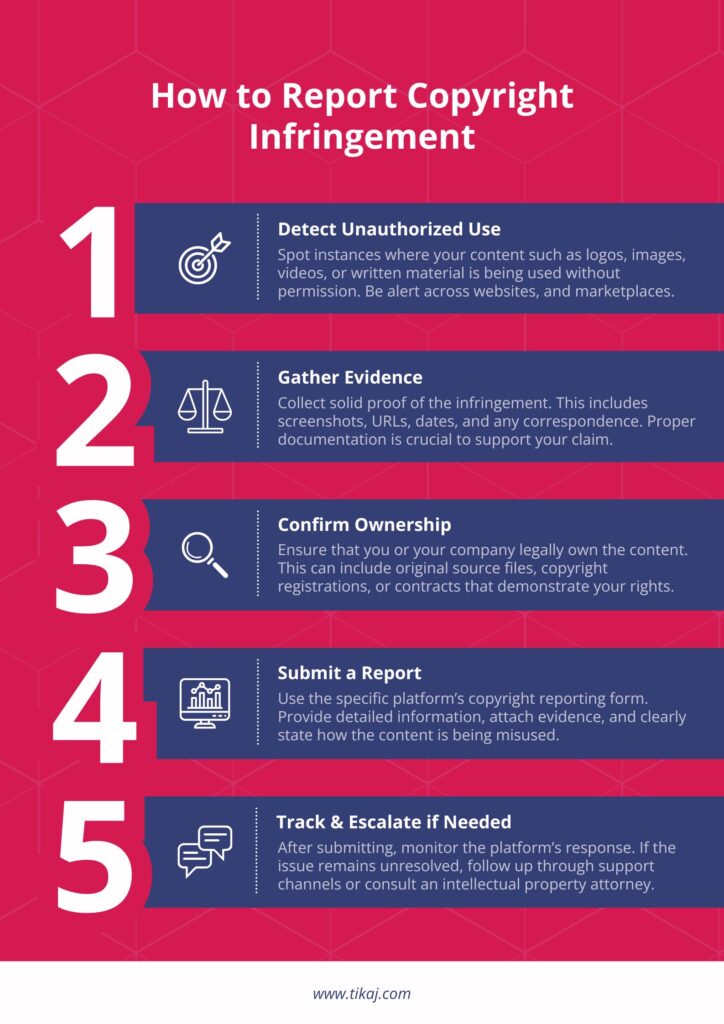
The steps are the same on every platform:
- Identify the infringement: full-page screenshots with URL and timestamp in frame, the permalink of each post or listing, the handle and numeric account ID (handles change, IDs do not).
- Verify ownership: dig out the original file with EXIF intact, where and when you first published it, or the agency contract if someone else shot it.
- Report it to the platform or directly to the infringer. We would go to the platform almost every time. A cease-and-desist DM is fine for a small business that copied a photo by mistake; a scam operator just reads it as a warning to move.
- Follow up: ticket number into the log, chase at the platform’s stated turnaround, lawyer if the same party resurfaces.
Platform by platform:
How Do I Report Copyright Infringement on Facebook?
Use Facebook’s Copyright Report Form. The Facebook Copyright Report Form starts by asking whether you own the rights or report for someone who does. After that: contact details, a description of the original with a link to it, every infringing URL, an e-signature, and a declaration. One thing people miss. Meta may hand your name and email to the account you reported, so file from brand@ or legal@, never from someone’s personal inbox, especially when the other side is a fraud ring.
Submit your claim. Facebook reviews it and either removes the content or warns the account; pages with repeated hits can be unpublished.
Monitor the outcome. Replies come by email, usually in a few days. Nothing back, or the post still live? Follow up with Facebook Support or get an IP lawyer to push. High-volume filers should ask for Meta’s Rights Manager instead of using the form each time.
How Do I Report Copyright Infringement on YouTube?
YouTube is where product demos and tutorials sit, so fintech and software brands get re-uploads there more than anywhere.
Use the YouTube copyright complaint webform. Go to the YouTube Copyright Infringement Form while signed in to a Google account, list each video URL, and add start and end timestamps if only part of it is yours.
It counts as a DMCA takedown notice. The form is a legal notice under the DMCA. Describe exactly what you own and how it is used. The uploader can see the claimant’s name.
Follow up. YouTube typically reviews claims within a week. You can ask for a scheduled removal, which gives the uploader 7 days to take the video down themselves before a strike is applied. A removal otherwise puts a copyright strike on the channel. The uploader can counter-notify, and if they do, the video can come back unless you go to court.
Reporting Copyright Infringement on Instagram
Same company as Facebook, same back office, slightly different form.
Open the Instagram copyright report form. Instagram’s Copyright Report Form wants a description of the work and the URL of each post or reel. Reels with your audio or your clip cut into someone else’s video count; so do Stories, though they expire in a day and you need the screenshot before they do.
Show you own it. Original high-res file, the link to your first post of it, or the licence if a photographer or agency holds the copyright and licensed it to you. That last case trips people up: if the agency kept the rights, it may have to file, not you.
Submit and track. The decision comes by email with a reference number. Save it. When the same handle reposts, quoting the old reference gets a faster look.
General Tips for Reporting Copyright Infringement
Precision first. One copyrighted work, one infringing URL, per line. “This account is stealing our content” gets closed without action and you start again with a fresh ticket while the page stays up.
Keep one folder per case, named by handle: screenshots, URLs, tickets, emails.
Speed matters because infringers pay attention. A fake page that lasts a week tells its operator your brand is slow, and the next one gets less effort and more reach.
A direct competitor, hundreds of copies, or an offshore host ignoring notices is work for an IP lawyer.
Additional Reporting Resources
Outside the social apps, find whoever can actually pull the content.
- Websites and blogs. Site owner first, then the host. WHOIS or RDAP on the domain, an IP-to-ASN lookup on whatever it resolves to, and you have the registrar, the hoster and their abuse@ addresses. If it resolves to Cloudflare, use Cloudflare’s abuse form, which forwards to the real host.
- Marketplaces (e.g., Amazon, eBay). There is a rights-owner IP complaint route that has nothing to do with normal seller support; Amazon Brand Registry helps once your mark is registered.
- Mobile app stores. Google Play and the Apple App Store both take IP complaints against apps copying your name, icon or code. Third-party APK sites rarely answer, so go to their host.
Conclusion
Fakes built from your own photos and screens are the believable ones. Knowing how to report copyright infringement on each platform, and having the evidence ready before you need it, is how you get them down.
In banks, online platforms, content aggregators, tech companies and e-commerce companies, fast takedowns come from clear ownership: one team, a shared mailbox, a case log.
Key Takeaways
- A copy made from your own material damages the brand more than an obvious fake, because customers cannot tell it apart.
- Facebook, YouTube and Instagram each have their own copyright report form, and all of them want post URLs, not profile links.
- Screenshot first, file the same day, keep the wording dry and factual.
- Same infringer for the third time, or a competitor? Get a lawyer.
Frequently asked questions (FAQ)
What actions can I take if the infringing content is not removed after reporting?
If the content is still live after your report:
- Follow up with the platform, quoting your reference number.
- Consider legal action. A copyright lawyer can send a formal notice to the infringer or advise on a claim.
- Report to the hosting provider. For a website, send the notice to the company hosting it as well as the site owner.
- Use DMCA services. Services such as DMCA.com can draft and send notices for you.
How long does it take for platforms to process copyright infringement reports?
It depends on the platform:
- Facebook & Instagram: typically respond within 24-72 hours.
- YouTube: reviews can take up to 7 days.
- Web hosts and app stores: depends on the provider’s policy, usually a few days.
What happens if someone falsely claims copyright infringement against my content?
If someone files a false copyright infringement report against you (a bad faith claim), you can:
- File a counter-notice on platforms such as YouTube and Facebook.
- Send proof that you own the content or are licensed to use it.
- Talk to a lawyer if the claim is doing real damage. Knowingly false claims can breach the DMCA and expose the claimant to legal consequences.
Can I report copyright infringement if I am not the copyright owner?
Only the copyright owner or someone authorised to act for them, like a lawyer or appointed agent, can report copyright infringement. If protecting your company’s intellectual property is your job, you can file for the company, as long as you can show that authority when asked.
You can also read – Master the art of removing Fake or Rogue Applications: A 4-Step Guide